UX Research Agency
Stop building on assumptions. We run the interviews, usability tests, and discovery sprints, then design the fix with you.









Since 2006
•
$320M+ lifetime client revenue powered by our software
•
4+ year avg. client relationship
Most product decisions happen in conference rooms, driven by whoever has the strongest opinion. UX research changes that dynamic by replacing internal debate with direct evidence from the people who actually use your product.
Research is the difference between building what users ask for and building what they need
What people say they want and what they need are often different. Behavior is shaped by context and habits that surveys can't capture. Good UX research observes real behavior, uncovers unmet needs, and turns both into product decisions.
Your team is shipping features users don't adopt.
Features that looked great in roadmap review launch to low adoption and a pile of confused support tickets. The problem usually isn't execution; it's building on an incomplete picture of user behavior. Research exposes those gaps before development starts.
Stakeholder opinions are driving your roadmap.
Without research, the loudest voice wins: the CEO's intuition, sales anecdotes, the support queue. None of it is malicious, but none of it is evidence. Structured research gives your team a shared evidence base and takes the politics out of prioritization.
You're making expensive bets without validation.
A platform redesign, a new onboarding flow, a pricing change: months of engineering and real revenue ride on each. Researching first isn't slowing down. It's how you avoid building the wrong thing at full speed. Even two weeks of discovery can reframe the whole initiative.
Research that ends in a better product, not a slide deck.
Our researchers and designers work on the same team. Interviews with ER nurses for Nursegrid revealed that full-moon shifts are a badge of honor. That went straight into the Recap we built for 600,000+ nurses, which drew 145K+ visits in 2024.
UX research and usability testing services
Uncover unmet needs, mental models, and behavioral patterns before your team commits to a direction - through in-depth interviews, contextual inquiry, and diary studies that reveal the "why" behind user behavior
Evaluate existing products and prototypes with real users to identify friction points, comprehension gaps, and failure modes before they ship - with moderated and unmoderated formats depending on your timeline and fidelity needs
Assess your existing product through a structured research lens - heuristic evaluation, expert review, and targeted user testing that identifies what's working, what's broken, and where the highest-leverage improvements live
A focused 2-4 week research engagement designed to answer a specific strategic question: should we build this? Who is it for? What problem does it actually solve? Discovery sprints give product and engineering teams the clarity they need to move forward with confidence
Design and field surveys that generate statistically meaningful insights - with questionnaire design, sampling strategy, and analysis that goes beyond surface-level satisfaction scores to surface actionable patterns
Embed continuous research into your product development cycle - with a recurring cadence of user interviews, usability sessions, and synthesis that keeps your team connected to user reality as your product evolves
How a UX research study works
We start by defining the research question precisely. What does your team need to know? What decisions will this research inform? What's already known, and where are the real gaps? A well-scoped research question is the difference between a study that generates actionable insight and one that produces interesting-but-inconclusive data. We align with your team on scope, timeline, and success criteria before a single interview is scheduled.
We select the methods that match your question and your constraints. Generative or evaluative? Qualitative or quantitative? Moderated or unmoderated? Longitudinal or point-in-time? Every methodological decision is made deliberately - not because a method is familiar, but because it's the right tool for what you need to learn. We design the research protocol, screener, and stimulus materials and review them with your team before fieldwork begins.
We conduct the research - recruiting participants, running sessions, and capturing data with the rigor that makes findings trustworthy. For moderated research, we bring experienced facilitators who know how to probe without leading, surface unexpected insights, and adapt in real time when something interesting emerges. We handle logistics so your team can observe, not manage.
Raw data doesn't answer research questions - synthesis does. We analyze findings across participants to identify patterns, map behavioral themes, and extract the insights that matter for your specific decisions. We don't bury the findings in a 90-slide deck - we structure them around the decisions your team needs to make, with clear implications and recommended next steps.
Research only creates value when it changes what a team does. We present findings in a format designed for activation - not just information transfer. That means clear recommendations, prioritized by impact, with direct connections to roadmap and design decisions. We stay involved through the decision-making process, helping your team interpret edge cases, weigh tradeoffs, and apply findings to the work in front of them.
UX research case studies

Brand & Product for a Digital Vault
A completely new identity and custom site build for Locket, a platform that helps people document, value, and protect their most meaningful possessions.
For Locket / Built with Vercel and Supabase
$10M+ in Value Stored Within 2 Weeks of Launch
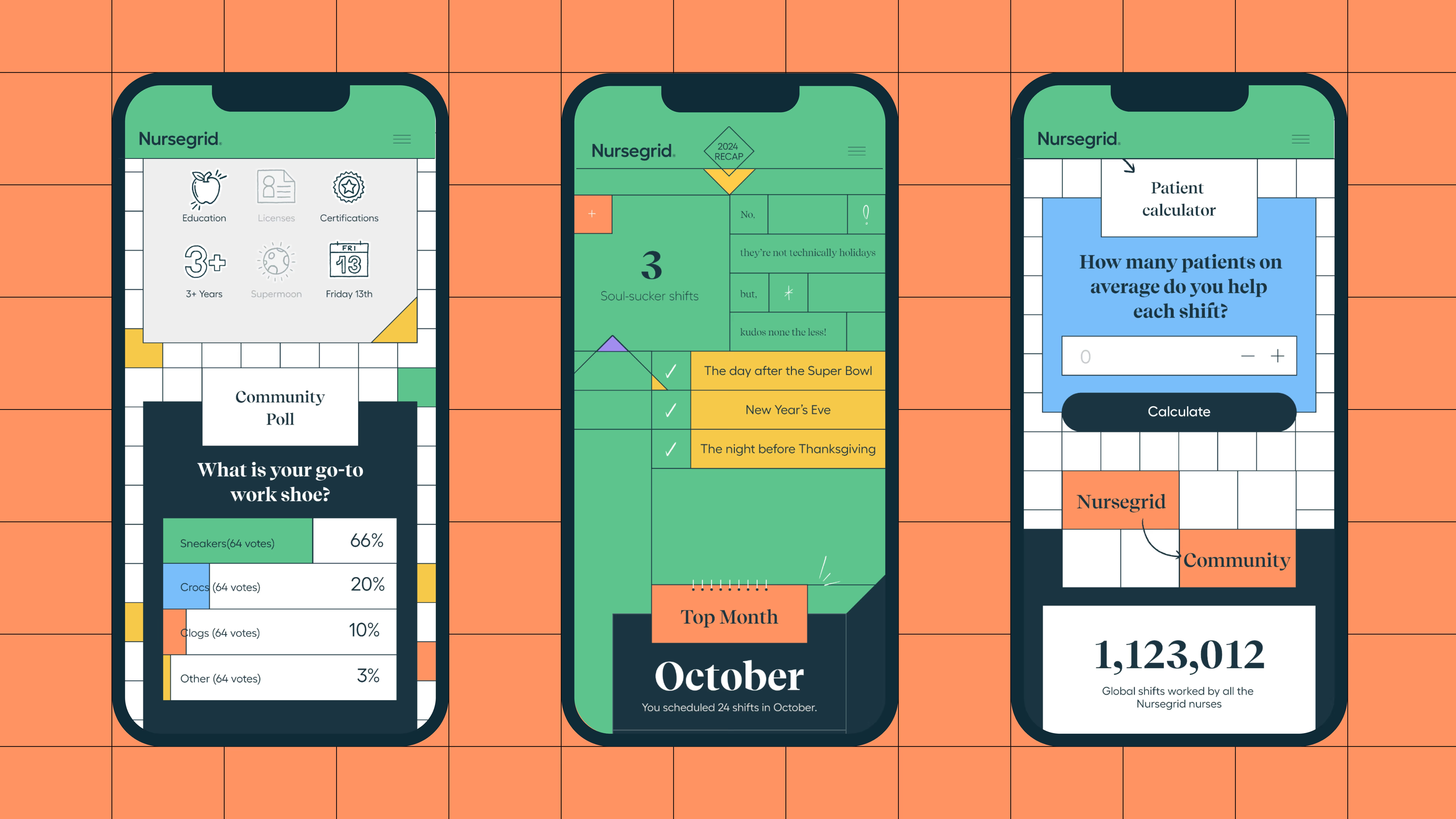
“Wrapped” Interactive Recap
A multi-year engagement campaign for Nursegrid, the #1 nurse scheduling app.
For Nursegrid / Built with Next.js and Cloudflare
145K+ Recap Visits in 2024
They're strategic and critical thinkers with a lot of experience, insights, and knowledge. They took their responsibilities beyond the scope of web development in everything they did.
Liza Streiff
CEO, Knopman Marks
UX research FAQ
What is UX research and why does it matter?
UX research is the practice of studying how real users interact with products - their behaviors, needs, mental models, and pain points - to inform better product decisions. It matters because intuition and internal opinion, no matter how experienced, are a poor substitute for direct evidence from the people who use your product. Teams that invest in research ship fewer wrong things, reduce expensive rework, and build products that users actually adopt.
How much does UX research cost?
Research engagements typically start around $15K for a focused study, with cost driven by method, number of participants, and timeline. A discovery sprint to de-risk a direction sits near the floor; a larger mixed-method study runs higher. Ongoing research support is structured as a monthly retainer, scoped separately.
What types of UX research does Coalesce offer?
We offer the full spectrum: generative research (discovery, interviews, contextual inquiry), evaluative research (usability testing, heuristic evaluation, UX audits), quantitative research (surveys, behavioral data analysis), and ongoing research retainers. We select and combine methods based on what your team needs to learn, not on a fixed methodology.
How long does a UX research engagement take?
A focused discovery sprint typically runs 2-4 weeks. Usability testing or evaluative studies can often be completed in 1-2 weeks. More comprehensive generative research programs - longitudinal studies, large participant samples, multi-method designs - run 4-8 weeks. We scope every engagement to your timeline and decision-making needs rather than defaulting to a fixed duration.
How do you recruit research participants?
We handle recruitment end-to-end. For most studies, we recruit from panel sources and screen participants against your user criteria. For studies requiring specialized populations - clinical professionals, specific job functions, niche user segments - we work with your team to identify recruitment channels and manage outreach. We screen rigorously to ensure participants reflect your actual user base, not a convenience sample.
How does UX research connect to product and design work?
At Coalesce, research doesn't happen in isolation - it feeds directly into the Product Studio's design and strategy work. Research findings inform wireframes, prototypes, design system decisions, and roadmap prioritization. Because our researchers and designers work together on the same team, insights don't get lost in translation between a research report and a design brief. The same people who learn what users need are involved in designing the solution.
When in the product development process should we do research?
The honest answer: earlier than you think, and more continuously than feels comfortable. Generative research is most valuable before a major initiative begins - before the team has committed to a direction. Evaluative research is valuable throughout the build cycle, testing assumptions at low fidelity before they become expensive to change. And ongoing research cadences keep teams connected to user reality as products scale and user needs evolve. If you're asking "is it too late for research?" - it's probably not, but the sooner the better.
What's the difference between UX research and usability testing?
Usability testing is one method within UX research. It evaluates how well users can accomplish specific tasks with an existing product or prototype - identifying friction, confusion, and failure points. UX research is broader: it encompasses the full range of methods used to understand user behavior, needs, and context, including research conducted before any product exists. Both are valuable, but they answer different questions. We use usability testing when you need to evaluate something that exists; we use other research methods when you need to understand a space before building.
What should you look for in a UX research agency?
Choose an agency that picks methods based on your question, not the one method it always sells; that can recruit your actual users, including specialized ones; and that connects findings to design decisions instead of stopping at a report. Ask how a past study changed what a team built. At Coalesce, researchers and designers work together, so findings go straight into wireframes, prototypes, and roadmap decisions.
Find out what your users actually need
Start with a discovery sprint. In 2-4 weeks, we'll answer the research question that's blocking your team - and give you the evidence you need to move forward with confidence.